Pi²R iD
Over the top
The Pi²R Display is the backbone of the Pi²R home system.
With builtin WiFi and USB Host Features, it is easy to download data or update software whether your home has dedicated internet or no internet at all.
The display communicates with other Pi²R modules over a network cable and can also draw power from the network to charge itself. The display can also power the bus in order to communicate with devices that do not have power. Data from external modules are gathered onto the logger itself and relayed to the internet of things via the display's WiFi.
Display
The display is a huge upgrade from previous models. We have done away with all push buttons and now use a touch sensitive LCD. The network physical layer protocol changed, enabling wire length to be extended. The display now have a chargeable Lithium battery to power the larger display and the WiFi.
Display features include:
-
3.5" Colour Touch LCD to display information about the system
-
WiFi to communicate with the IoT (internet of things)
-
Memory enough to store 6 months worth of data
-
Micro logger with 6 inputs (4 Analog, 2 Digital)
-
USB Host to export data in Excell format directly to FLASH Drive
-
Battery enough to power the logger and display for 12 hours
-
WiFi
The display can connect to a 2.4Ghz WiFi networks to send data to a central server from where the Cellphone app can access data even when the user is not at home. The WiFi can be disabled when not required.
The WiFi connection is safe to use on a mobile hot spot as it uses very little data.
iOS & Android app
The app allows users to monitor multiple installations simultaneously.
Memory
Data are stored on the 16MByte embedded FLASH memory and sent through to the server when WiFi is available. When no WiFi is available, all data is timestamped and stored onto the FLASH. When no WiFi is available, Logger time and date needs to be set in the menu. When WiFi is available, time and date is automatically synchronized with international time servers for accuracy. Data can alternatively be downloaded via USB onto a flashdrive.
Micro logger
The Logger can take four analog inputs, which can be used to measure circuit breakers in the distribution board (DB). Although any 3rd party 3.3V Arduino current sensor should also work on our system, we cannot test all 3rd party sensors to give a comprehensive list.
We offer a standard in-line type 20Amp sensor for most projects, but other capacity sensors are also available. We use a generic 3.3Volt allegro hall effect sensor commonly found inside Arduino modules. Efergy split core CT's are also available, although they are too large for most installations.
Sensors are probed continously and a true RMS value calculated and averaged over the 5min interval until the measurement is timestamed and saved onto FLASH memory.
The Logger can also take two pulse inputs, which can be connected to water or power meters that support pulse output. Most elster water meters and elster power meters give out pulses when a set unit of measure is counted (optional probes may be required from the meter manufacturer).
The Logger can also communicate with external devices over a High speed RS485 network to expand capabilities. The Logger can communicate with the Pi²R Smart and the Inverter in this manner.
USB Host
The Logger can interface with a USB 2.0 Full speed device. We have built-in drivers to handle the generic MSD type FLASH drives with FAT filesystem. Currently other filesystems do not work with our embedded drivers.
Data can be exported to Excell CVS files to visualize your data on any spreadsheet editor.
Battery
For normal installations we supply a 1100mAh battery standard. External sensors can use a significant amount of power and will drain the battery faster. The LCD backlight can also draw a considerable amount of power and shorten battery life. Althoug the sensors and LCD can drain the battery fast, it should easily last through even the longest loadshedding.
For Off-grid installations there is an optional 2200mAh battery available for extended service when no power is available.
Display modes
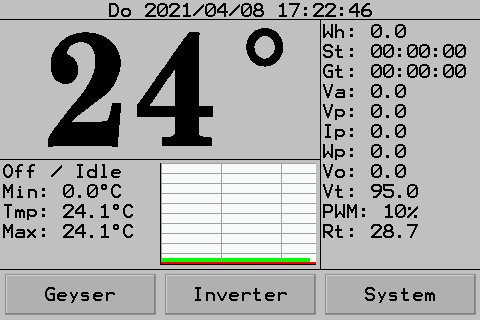
There are multiple modes of operation. The main screen can be set up to show a default set of variables when needed. This enables the user to instantly see what is important to that specific installation without searching first.
Technical Specifications
LCD > 3.5" 16-Bit depth
LCD > TouchResistive
Battery > 1100mAh / 2200mAh Option
Memory > 16MByte / 100,000 Cycles / 10year retention
Digital Sensors > 2x Pulse Inputs, 10Hz max / Temperature & Humidity Optional
Analog Sensors > 4x Inputs True RMS / Chip type: 1.65V Center or CT type
Network BUS > RS485 up to 100m / 115200,8n1 / 6 Core STP cable
Operating Temperature > -10 - 85° Celsius / Non condensing
Charge input > 8 - 20Vdc
Certification > ICASAYes
EMI/EMC > Compliant